

The cheetah is one of the most fascinating animals in the wild. Known as the fastest land animal on Earth, this incredible big cat can reach remarkable speeds when chasing its prey. Its slender body, long legs, and spotted coat make it easy to recognize.
But there is much more to cheetahs than their impressive running ability. They have unique hunting techniques, interesting social behaviors, and special adaptations that help them survive in challenging environments.
In this guide, we will explore interesting cheetah facts, including how fast cheetahs can run, what they eat, where they live, and why their populations need protection.
What Is a Cheetah?
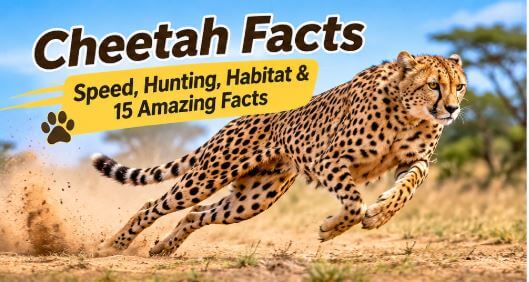
The cheetah (Acinonyx jubatus) is a large wild cat belonging to the family Felidae. It is best known for its incredible acceleration and ability to reach high speeds over short distances.
Unlike lions and tigers, cheetahs have a slim, lightweight body designed for running rather than fighting. Their long legs, flexible spine, deep chest, and long tail help them move quickly and change direction while chasing prey.
Cheetahs also have several distinctive physical features:
- A yellowish or tan coat covered with black spots.
- Two dark tear-shaped lines running from the eyes toward the mouth.
- Long, slender legs built for speed.
- A long tail that helps with balance and turning.
- Semi-retractable claws that provide traction while running.
Each cheetah has a unique pattern of spots, making individual animals easier to recognize.
15 Interesting Cheetah Facts
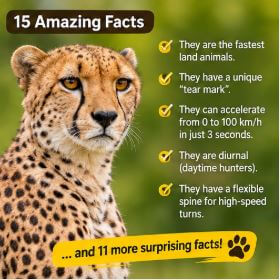
1. Cheetahs Are the Fastest Land Animals
One of the most famous cheetah facts is their extraordinary speed.
Cheetahs can reach approximately 60 to 70 miles per hour during short bursts. This makes them faster than any other land mammal.
However, they cannot maintain this speed for long. Sprinting requires enormous energy, so a cheetah usually needs to rest after an intense chase.
2. Cheetahs Can Accelerate Extremely Quickly
Cheetahs are not only fast; they can also accelerate remarkably quickly.
According to the Smithsonian’s National Zoo, a cheetah can accelerate from zero to approximately 45 miles per hour in just 2.5 seconds.
This rapid acceleration gives the animal an important advantage when chasing fast-moving prey.
3. Every Cheetah Has a Unique Spot Pattern
A cheetah’s coat is covered with small black spots that help it blend into its surroundings.
These spots provide camouflage among grasses, shadows, and vegetation.
Interestingly, each cheetah has its own distinctive spot pattern, similar to how humans have unique fingerprints.
4. Cheetahs Have Black Tear Marks on Their Faces
Two dark lines run from the inner corners of a cheetah’s eyes down toward its mouth.
These markings are often called tear marks. They may help reduce glare from bright sunlight, making it easier for cheetahs to see while hunting during the day.
5. Cheetahs Cannot Roar Like Lions
Although cheetahs belong to the cat family, they cannot produce the powerful roar associated with lions and tigers.
Instead, they communicate using different sounds, including chirping, purring, growling, hissing, and barking.
6. Cheetahs Are Mainly Active During the Day
Cheetahs are primarily diurnal, meaning they are active during daylight hours.
They often hunt in the early morning or late afternoon, when temperatures may be more comfortable and visibility is still good.
7. Cheetahs Have Semi-Retractable Claws
Unlike most cats, cheetahs cannot fully retract their claws.
Their claws remain partly exposed, helping them grip the ground while running.
8. A Cheetah Uses Its Tail Like a Rudder
A cheetah’s long tail helps it maintain balance and make sharp turns while running at high speed.
This ability is especially important when chasing prey that suddenly changes direction.
9. Cheetahs Depend More on Sight Than Smell When Hunting
Cheetahs often scan open landscapes from elevated positions, such as termite mounds or rocky outcrops.
Their excellent eyesight helps them identify potential prey from a distance.
10. Cheetahs Need to Rest After a Chase
Running at extreme speeds places enormous physical demands on a cheetah’s body.
After a successful hunt, a cheetah may need time to recover before eating.
11. Female Cheetahs Usually Live Alone
Adult female cheetahs generally live independently, except when they are raising their cubs.
They move across large areas in search of prey, water, and suitable places to raise their young.
12. Male Cheetahs Sometimes Form Coalitions
Male cheetahs may live alone or form small groups called coalitions.
Coalition members often cooperate when defending territories and competing with other males.
13. Cheetah Cubs Face Many Dangers
Young cheetahs are vulnerable to predators, environmental changes, and other threats.
Lions, hyenas, and other large predators may kill cheetah cubs.
Their mother protects them and teaches them important survival skills as they grow.
14. Cheetahs Eat Mostly Small to Medium-Sized Animals
Cheetahs are carnivores that mainly hunt animals such as gazelles, impalas, and other small antelope.
Depending on their location, they may also eat hares, game birds, and young individuals of larger species.
15. Cheetahs Are Facing Serious Conservation Challenges
Habitat loss, conflict with people, declining prey populations, and illegal wildlife trade are among the major threats to cheetah survival.
Although conservation programs are working to protect them, cheetahs still need large, connected habitats.
How Fast Can a Cheetah Run?
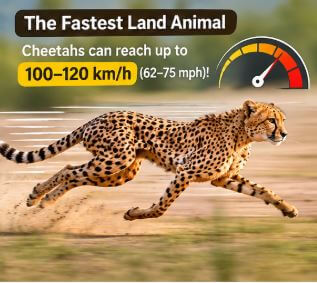
Cheetahs are famous for their incredible running ability.
They can reach speeds of approximately 60 to 70 miles per hour during short sprints. Their acceleration is also exceptional, allowing them to move from a standing position to high speed in only a few seconds.
A Lightweight Body
Cheetahs have a slender body and relatively lightweight frame. These characteristics help reduce the effort needed to accelerate.
Long Legs and a Flexible Spine
Their long legs and flexible spine allow them to cover a large distance with each stride.
As the cheetah runs, its spine flexes and extends, helping lengthen its stride.
Large Lungs and Nasal Passages
Cheetahs have large nasal passages and lungs that support rapid breathing during intense physical activity.
A Long Tail for Balance
Their long tail acts like a rudder, helping control movement and maintain balance when turning at high speed.
Despite these adaptations, cheetahs cannot sprint indefinitely. Their incredible speed is designed for short bursts rather than long-distance running.
How Do Cheetahs Hunt?
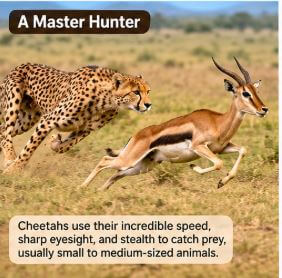
Cheetahs use a combination of excellent eyesight, patience, camouflage, and speed to catch prey.
Step 1: Finding Prey
A cheetah scans the surrounding landscape for animals such as gazelles and other small antelope.
Step 2: Approaching Quietly
Once it selects a target, the cheetah moves closer while using vegetation and natural cover to remain hidden.
Step 3: The High-Speed Chase
When the moment is right, the cheetah suddenly accelerates toward its prey.
It uses its long legs, flexible spine, and powerful muscles to move quickly.
Step 4: Catching the Prey
If the chase is successful, the cheetah uses its forelegs to trip the animal.
It then bites the prey around the throat to suffocate it.
Step 5: Recovering and Eating
After a demanding chase, the cheetah often needs time to recover before eating.
It must also remain alert because stronger predators, including lions and hyenas, may steal its food.
What Do Cheetahs Eat?
Cheetahs are carnivores, meaning they eat other animals to obtain the nutrients they need.
Common prey includes:
- Gazelles
- Impalas
- Springboks
- Steenboks
- Duikers
- Young warthogs
- Hares
- Game birds
Their exact diet depends on the region and the availability of prey.
Cheetahs generally hunt animals that they can chase and overpower without engaging in a prolonged fight.
Where Do Cheetahs Live?
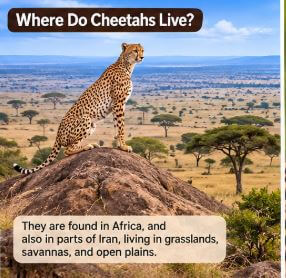
Today, wild cheetahs are found mainly in parts of eastern and southern Africa.
They inhabit several types of environments, including open grasslands, savannas, semi-arid regions, open woodlands, and areas with scattered bushes and vegetation.
These habitats provide the space and visibility needed for hunting.
Do Cheetahs Live in Asia?
Yes, but their Asian population has become extremely small.
The Asiatic cheetah once occupied a much larger area across parts of Asia. Today, the remaining wild population is restricted to Iran.
This population is critically endangered and faces serious survival challenges.
Cheetah Behavior and Social Life
Cheetahs have a social structure that differs from many other big cats.
Female Cheetahs
Female cheetahs generally live alone outside the breeding period.
After giving birth, a mother raises her cubs and teaches them how to survive.
Male Cheetahs
Male cheetahs may live alone or form coalitions.
Coalitions are often made up of brothers, although unrelated males may also form groups.
How Do Cheetahs Communicate?
Cheetahs communicate through sounds, scent marking, and body language.
Their vocalizations include chirps, purrs, growls, and hisses.
Why Are Cheetahs Endangered?
Cheetahs are classified as Vulnerable on the IUCN Red List, and some populations and subspecies face much greater risks.
1. Habitat Loss
Agricultural expansion, infrastructure development, and human settlement can reduce the amount of suitable habitat available to cheetahs.
2. Human-Wildlife Conflict
Cheetahs sometimes come into conflict with farmers and livestock owners.
3. Declining Prey Populations
Cheetahs depend on wild prey for survival. Hunting pressure and habitat degradation can reduce prey availability.
4. Illegal Wildlife Trade
Illegal trade remains a concern, particularly involving young cheetahs.
How Can We Help Protect Cheetahs?
Important conservation actions include:
- Protecting natural habitats and wildlife corridors.
- Reducing conflict between farmers and predators.
- Supporting responsible wildlife conservation organizations.
- Combating illegal wildlife trade.
- Educating communities about the ecological importance of cheetahs.
Frequently Asked Questions About Cheetahs
1. Are cheetahs faster than lions?
Yes. Cheetahs are much faster than lions over short distances. Their bodies are specially adapted for acceleration and high-speed sprints, while lions rely more on strength and power.
2. How fast can a cheetah run?
A cheetah can reach approximately 60 to 70 miles per hour during a short sprint, making it the fastest land mammal.
3. What do cheetahs eat?
Cheetahs mainly eat small and medium-sized animals, including gazelles, impalas, springboks, hares, and game birds.
4. Where do cheetahs live?
Most wild cheetahs live in eastern and southern Africa. A small population of Asiatic cheetahs survives in Iran.
5. Can cheetahs climb trees?
Cheetahs can climb trees in some situations, but they are not as well adapted to climbing as leopards.
6. Do cheetahs live in groups?
Female cheetahs generally live alone or with their cubs. Male cheetahs may live alone or in small groups called coalitions.
7. Can cheetahs roar?
No. Cheetahs cannot roar like lions and tigers. Instead, they make sounds such as chirping, purring, growling, and hissing.
8. How long do cheetahs live?
Lifespan varies depending on environmental conditions and whether the animal lives in the wild or under human care.
9. Are cheetahs dangerous to humans?
Cheetahs are wild predators and should never be approached or treated as pets. Like other wild animals, they may defend themselves if threatened.
10. Why do cheetahs have spots?
Their spots help them blend into grasslands and other natural environments. This camouflage can make it easier to approach prey and hide from potential threats.
Conclusion
Cheetahs are remarkable animals with an extraordinary combination of speed, agility, and hunting ability.
From their distinctive spotted coats to their flexible spines and powerful legs, every part of their body helps them survive in the wild.
However, being the fastest land animal does not guarantee survival. Habitat loss, human-wildlife conflict, and declining prey populations continue to threaten cheetah populations.
Understanding these amazing animals is an important step toward appreciating wildlife and supporting conservation efforts.
By protecting their habitats and reducing threats, we can help ensure that future generations will continue to see cheetahs roaming across the African landscape.
References
The information in this article is based on research and educational resources from wildlife conservation organizations, zoological institutions, and scientific specialists.
- Smithsonian’s National Zoo & Conservation Biology Institute. Cheetah.
https://nationalzoo.si.edu/animals/cheetah
Useful for: physical characteristics, running speed, adaptations, diet, habitat, behavior, and reproduction. - San Diego Zoo Wildlife Alliance. Cheetah.
https://animals.sandiegozoo.org/animals/cheetah
Useful for: cheetah biology, hunting behavior, habitat, diet, physical adaptations, and life cycle. - Cheetah Conservation Fund. About Cheetahs.
Useful for: cheetah speed, prey, cub development, threats, and conservation efforts. - IUCN/SSC Cat Specialist Group. Living Species – Cheetah.
https://www.catsg.org/living-species-cheetah
Useful for: species characteristics, scientific information, adaptations, hunting behavior, and conservation research. - Smithsonian’s National Zoo & Conservation Biology Institute. Why Do Cheetahs Have Spots? And Other Cheetah Facts.
https://www.nationalzoo.si.edu/animals/news/why-do-cheetahs-have-spots-and-other-cheetah-facts
Useful for: frequently asked questions about cheetah spots, sounds, speed, hunting, and habitat.
Sources accessed: November 2026.