

Tigers are powerful carnivores and some of the most impressive hunters in the animal kingdom. But what do tigers eat in the wild? Their diet mainly consists of deer, wild pigs, and other medium- to large-sized animals. Depending on where they live, tigers may also hunt buffalo, antelope, monkeys, birds, fish, and other available prey.
Unlike animals with highly specialized diets, tigers can adapt to different prey species across their range in Asia. Their food choices depend on habitat, prey availability, and the size of the animals living nearby.
In this guide, you will learn what tigers eat, how they hunt, how their diets differ by region, and how much food these large cats can consume.
What Do Tigers Eat in the Wild?
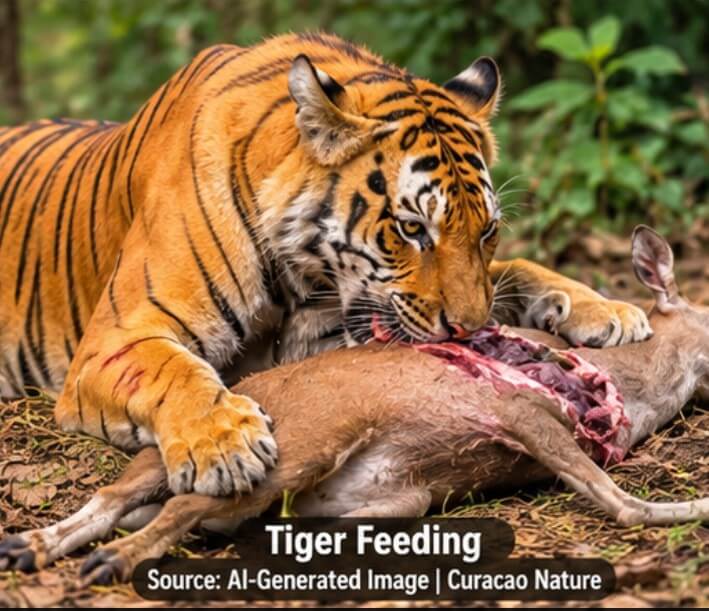
Tigers are obligate carnivores, meaning they depend on animal-based food to meet their nutritional needs. Their natural diet is made up primarily of wild mammals, especially hoofed animals known as ungulates.
- Deer: Various deer species are important food sources, including sambar, chital, and other regional species.
- Wild boar: Wild pigs are a major prey animal in many tiger habitats.
- Wild cattle and buffalo: Larger tigers may hunt large bovids when conditions allow.
- Antelope: Some tiger populations prey on antelope species found in their local habitats.
- Smaller mammals: Monkeys, rodents, hares, and other small mammals may also become prey.
- Birds and reptiles: Tigers occasionally consume birds, reptiles, and other smaller animals.
The exact diet differs from one tiger population to another. Prey species available in the forests of India are not necessarily the same as those found in the Russian Far East or the Indonesian islands.
What Animals Do Tigers Hunt?
Tigers are opportunistic hunters. They usually target animals that provide enough food to justify the energy required to catch them.
1. Deer
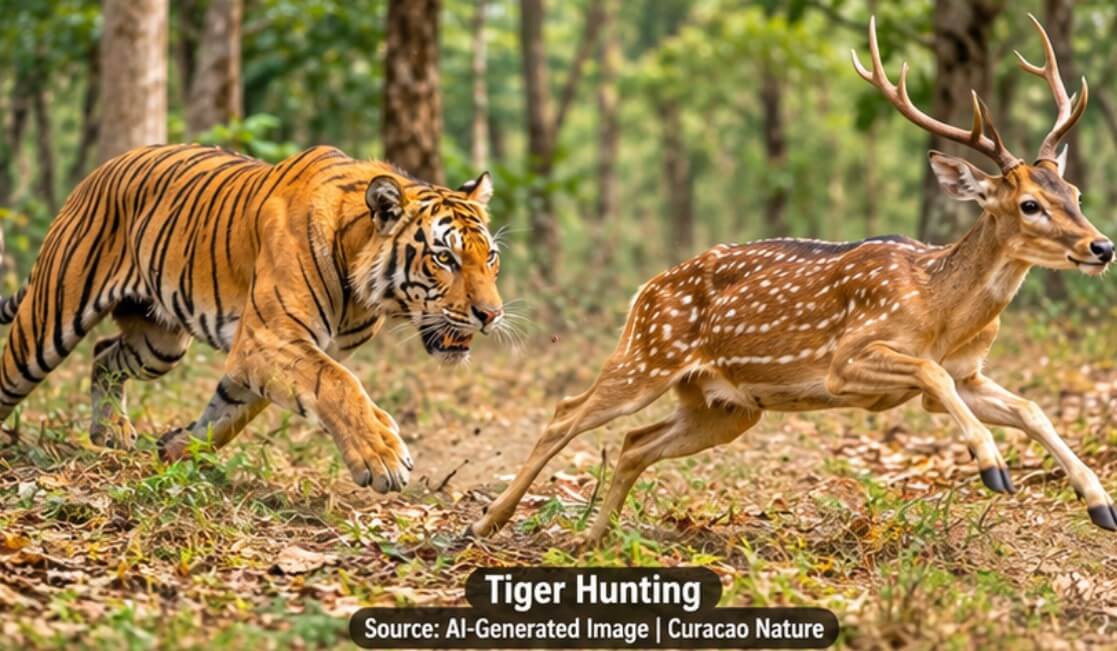
Deer are among the most important prey animals for many tiger populations. Depending on the region, tigers may hunt sambar deer, chital (spotted deer), red deer, muntjac (barking deer), and other local species. In parts of India, sambar and chital are particularly important prey.
2. Wild Boar

Wild boar are another significant food source. They occur in many Asian forests and can provide a substantial meal. Hunting them can be dangerous because adult wild boar have strong bodies and sharp tusks. Tigers generally rely on stealth and a close-range attack rather than long-distance pursuit.
3. Buffalo and Wild Cattle
Large bovids, including wild cattle and buffalo, can be prey for tigers. These animals are powerful and potentially dangerous, so hunting them requires considerable strength and an opportunity to approach without being detected. Tigers do not necessarily hunt the largest available animal; risk and accessibility matter.
4. Monkeys and Other Small Mammals
Tigers may also eat monkeys, langurs, hares, rodents, and other smaller mammals. These animals can become important food sources when larger prey is less available.
5. Birds, Fish, and Reptiles
Tigers are capable swimmers and are comfortable around water. Their diet may occasionally include fish, birds, reptiles, amphibians, and other small animals. These foods are not necessarily the main part of their diet.
How Do Tigers Hunt Their Prey?
Tigers are solitary ambush predators. Instead of chasing prey over long distances, they use camouflage, patience, and strength to approach an animal as closely as possible.
1. Finding Suitable Prey
Tigers use their senses, especially sight and hearing, to locate potential prey. They often hunt where animals gather to feed, drink, or move through forest paths.
2. Stalking Quietly
A tiger approaches its target slowly, using vegetation, shadows, and natural terrain for cover. Its striped coat helps break up its outline in environments with tall grass, trees, and patches of sunlight.
3. Attacking at Close Range
When the distance is short enough, the tiger launches a sudden attack. Its powerful legs, sharp claws, strong jaws, and large canine teeth help it overpower prey.
4. Feeding and Protecting the Kill
After a successful hunt, a tiger may drag its prey into a more concealed location before feeding. It can cover leftover food with vegetation, soil, or other material and return to the carcass later.
Not every hunt succeeds. A tiger must balance the energy it spends hunting against the potential nutritional value of its prey.
Do All Tigers Eat the Same Food?
No. Tiger diets vary considerably across their geographic range. Different habitats support different prey species, so a tiger living in a tropical forest may eat different animals from one living in a colder temperate forest.
Bengal Tigers
Bengal tigers live mainly in India, with populations also found in neighboring countries. Their prey can include chital, sambar deer, wild boar, nilgai, gaur, and other locally available mammals. In some landscapes, livestock may also become part of their diet, particularly where human settlements and tiger habitats overlap.
Amur Tigers
Amur tigers live in the Russian Far East and nearby areas. Their prey includes animals adapted to colder forest environments, such as red deer, wild boar, roe deer, sika deer, and elk in some areas. Prey availability changes with seasons and local habitat conditions.
Sumatran Tigers

Sumatran tigers inhabit the Indonesian island of Sumatra. Their prey includes sambar deer, muntjac, wild boar, and other mammals found in the island’s forests. Their island habitat supports a different prey community from the continental tiger’s range.
These regional examples show why tiger diets should be discussed in relation to geography rather than treated as identical everywhere.
How Much Do Tigers Eat?
Tigers can consume a large amount of meat after a successful hunt. The Smithsonian’s National Zoo reports that tigers may eat as much as 75 pounds (about 34 kilograms) in one night. WWF also notes that a tiger can consume more than 80 pounds in one feeding occasion. These are large-meal examples, not a fixed daily requirement for every tiger.
The amount a tiger eats depends on several factors:
- The size of the prey animal
- The tiger’s body size and age
- Whether the tiger has recently eaten
- The availability of food
- Its activity level and condition
A tiger may eat heavily after killing a large animal and then return to the carcass over the following days.
How Often Do Tigers Hunt?
Tigers do not necessarily need to hunt every day. The Smithsonian’s National Zoo describes wild tigers as typically hunting about once a week. However, actual hunting frequency varies according to prey availability, hunting success, and the size of each meal.
A successful kill may provide enough food for several feeding sessions. If a tiger fails to catch prey, it may need to continue hunting until it obtains another meal.
Do Tigers Eat Humans?
Humans are not a normal or preferred food source for tigers. However, attacks on people can occur in areas where people and tigers share landscapes. Some incidents involve defensive behavior, surprise encounters, or individual tigers that have become more likely to approach human settlements.
It is important not to describe every tiger as a man-eater. Reducing habitat disturbance, protecting natural prey, and managing encounters between people and wildlife are important parts of tiger conservation.
Do Tigers Eat Plants?
Tigers are obligate carnivores. Meat is essential to their diet, and plants do not provide the nutrition they need to survive. A tiger may occasionally swallow small amounts of plant material accidentally while eating prey or grooming. That does not mean plants are a meaningful part of its diet.
What Do Tigers Eat in Zoos?
The diet of a tiger in a zoo is different from that of a wild tiger. Professional animal-care teams provide carefully managed diets designed to meet the animal’s nutritional needs. These diets may include prepared meat, whole prey items, bones, and nutritional supplements.
The Smithsonian’s National Zoo describes feeding its tigers a formulated carnivore diet along with meat and other enrichment foods. Zoo diets should not be used as a direct representation of what tigers naturally hunt in the wild.
Why Is a Tiger’s Diet Important to Its Ecosystem?
Tigers are apex predators in many of the ecosystems they inhabit. By hunting herbivores and other animals, they form part of the natural processes that influence prey populations and food-web relationships.
Their survival depends on more than protecting individual tigers. Conservation efforts must also protect the animals they eat and the habitats that support those prey populations. When forests are fragmented or prey populations decline, tigers may have fewer opportunities to find natural food. In some landscapes, this can increase the likelihood of livestock predation and conflict with nearby communities.
Frequently Asked Questions
What is a tiger’s favorite food?
Tigers do not have one universal favorite food. Deer and wild pigs are important prey across many parts of their range, but preferred prey depends on what is available locally.
Do tigers eat deer?
Yes. Deer are among the most important prey animals for many tiger populations. Species include sambar, chital, muntjac, and other regional deer.
Do tigers eat wild boars?
Yes. Wild boar are a common prey species in several tiger habitats.
Do tigers eat elephants?
Tigers may occasionally attack young elephants, but adult elephants are generally too large and dangerous to be normal prey.
Do tigers eat fish?
Tigers may eat fish, although fish are not a primary food source for most tiger populations.
Are tigers carnivores or omnivores?
Tigers are carnivores and depend on meat for their nutritional needs.
How much meat can a tiger eat at once?
A tiger can consume a very large meal. The Smithsonian’s National Zoo reports that a tiger may eat up to 75 pounds (about 34 kilograms) in one night, although the amount varies.
Final Thoughts
So, what do tigers eat? Their diet mainly consists of deer, wild boar, and other medium- to large-sized animals. Depending on their habitat, they may also consume buffalo, antelope, monkeys, birds, fish, reptiles, and smaller mammals.
Tigers are adaptable hunters, but their survival depends on healthy ecosystems with enough natural prey. Protecting tiger habitats and the animals they hunt is essential to ensuring that these magnificent predators continue to survive in the wild.
Editor Notes – Do Not Copy into the Article Body
Suggested Internal Links
- Wild Animals — anchor: wild animals — pillar page; confirm the published URL.
- What Do Lions Eat? — anchor: what lions eat — article #1; confirm the published URL.
- What Do Wolves Eat? — anchor: what wolves eat — planned article; link only after publication.
- What Do Hyenas Eat? — anchor: what hyenas eat — planned article; link only after publication.
- Cheetah Facts — anchor: cheetah facts — planned article; link only after publication.
Research Sources to Verify Before Publication
- Smithsonian National Zoo – Tiger: https://nationalzoo.si.edu/animals/tiger
- IUCN Cat Specialist Group: https://www.catsg.org/
- San Diego Zoo Wildlife Alliance – Tiger: https://animals.sandiegozoo.org/animals/tiger
- Journal of Mammalogy – Terai-Arc tiger prey research (2023): verify the exact article landing page and bibliographic details.
- WWF – Tiger: https://www.worldwildlife.org/species/tiger
WordPress Publishing Checklist
- Copy only the article body into WordPress; keep the SEO brief and Editor Notes outside the post body.
- Enter the SEO title, meta description, and slug separately in Rank Math.
- Verify all cited facts and source URLs before publishing.
- Use only properly licensed photographs or clearly labeled AI-generated illustrations; never present AI images as wildlife photographs.
- Add descriptive alt text and captions, and verify image rights and attribution.
- Add internal links only to pages that are actually published.
- Review the article on mobile and check heading, list, and FAQ formatting.