

Hyenas are among the most misunderstood animals in the African wilderness. Often portrayed as sneaky scavengers that steal food from other predators, these fascinating mammals are actually skilled hunters, intelligent problem-solvers, and important members of their ecosystems.
The spotted hyena is especially famous for its unusual laugh-like calls, powerful jaws, and complex social groups known as clans. However, not all hyenas look or behave the same way. The hyena family includes four living species, each with its own appearance, diet, and lifestyle.
So, what makes hyenas so remarkable?
In this guide, you’ll discover interesting hyena facts, including where hyenas live, what they eat, how they hunt, why they laugh, and the important role they play in nature.
1. What Is a Hyena?
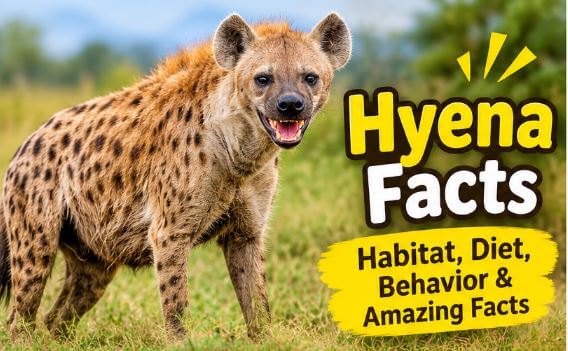
A hyena is a carnivorous mammal belonging to the family Hyaenidae. Although hyenas have a dog-like appearance, they are not members of the dog family. They belong to their own distinct mammalian family and are more closely related to cats and other members of the suborder Feliformia.
Hyenas are native to Africa and parts of Asia. Depending on the species, they may live in savannas, grasslands, rocky areas, woodlands, scrublands, and semi-desert environments.
Hyenas are known for their strong jaws, powerful teeth, excellent senses, and ability to make use of different food sources.
There are four living species of hyena:
- Spotted hyena (Crocuta crocuta): The best-known species, recognized by its spotted coat, powerful build, and distinctive vocalizations.
- Striped hyena (Hyaena hyaena): A generally solitary species with a grayish coat and dark vertical stripes.
- Brown hyena (Parahyaena brunnea): A shaggy-coated species found in parts of southern Africa.
- Aardwolf (Proteles cristata): A smaller, specialized hyena that feeds mainly on termites rather than large animal prey.
Although they belong to the same family, these four species have very different lifestyles. This article focuses mainly on the spotted hyena when discussing clan behavior, group hunting, and the famous laughing call.
2. 15 Interesting Hyena Facts
Here are 15 fascinating facts about hyenas that reveal why these animals deserve more respect than their reputation suggests.
- Hyenas are not dogs. Despite their dog-like appearance, they belong to the family Hyaenidae.
- There are four living hyena species. They are the spotted hyena, striped hyena, brown hyena, and aardwolf.
- Spotted hyenas live in clans. These social groups can contain many individuals and have complex relationships.
- Female spotted hyenas dominate males. Their society is organized around female-led social hierarchies.
- Hyenas are skilled hunters. Spotted hyenas can hunt successfully instead of relying only on leftovers.
- They are also scavengers. Hyenas feed on carcasses when opportunities arise.
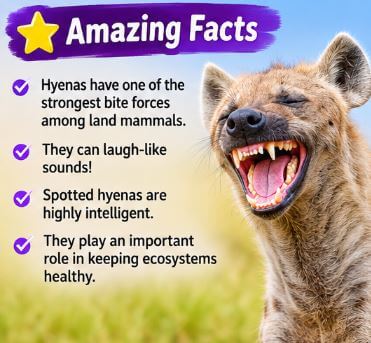
- Their jaws are extremely powerful. Spotted hyenas can crush and consume many parts of an animal carcass, including bones.
- The spotted hyena has a famous laugh-like call. This vocalization is associated with excitement, stress, or social interactions rather than human-style laughter.
- Not all hyenas laugh. The famous giggling call is especially associated with spotted hyenas.
- Hyenas communicate in several ways. They use calls, scent marks, and body language.
- They have strong digestive systems. Spotted hyenas can digest many parts of prey that other carnivores leave behind.
- Aardwolves eat mainly termites. Unlike other hyenas, they are specialized insect feeders.
- Hyenas help clean ecosystems. By consuming carcasses, they help recycle nutrients and reduce animal remains.
- They compete with lions. Spotted hyenas and lions may compete for prey and carcasses in overlapping habitats.
- Their social lives are surprisingly complex. Spotted hyena clans have relationships and dominance structures that scientists have studied for decades.
3. Where Do Hyenas Live?
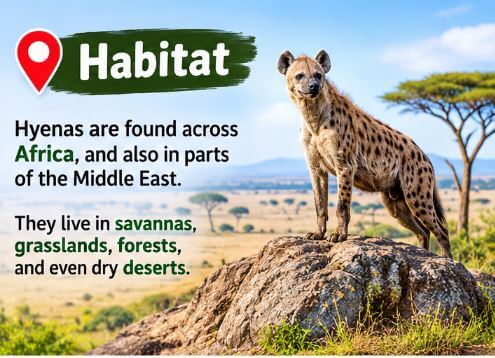
Hyenas live in different environments across Africa and parts of Asia. Their distribution depends on the species.
Spotted Hyena Habitat
Spotted hyenas are found across much of sub-Saharan Africa. Their habitats include:
- African savannas
- Open grasslands
- Woodlands
- Scrublands
- Semi-arid regions
- Some mountainous and forested areas
They are adaptable animals and can survive in a variety of landscapes as long as food and suitable shelter are available.
Striped Hyena Habitat
Striped hyenas have a broader range across parts of North and East Africa, the Middle East, and Asia.
They are associated with dry environments such as rocky hills, scrublands, semi-deserts, and open landscapes. They are generally more solitary than spotted hyenas.
Brown Hyena Habitat
Brown hyenas are mainly found in southern Africa, particularly in dry regions.
They inhabit areas such as deserts, semi-deserts, scrublands, and coastal environments. They often travel long distances while searching for food.
Aardwolf Habitat
Aardwolves live in parts of eastern and southern Africa, especially in open grasslands and savannas.
Unlike other hyenas, they depend heavily on termites, so their distribution is closely connected to the availability of suitable insect prey.
4. What Do Hyenas Eat?
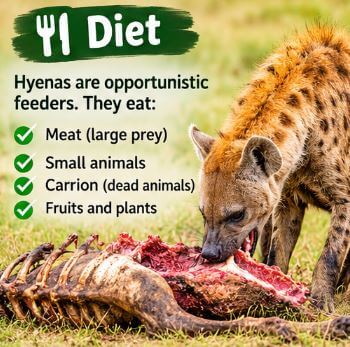
Hyenas are carnivorous mammals, but their diets vary significantly between species.
Spotted hyenas eat a wide variety of animal prey. Their food can include:
- Antelope and gazelles
- Zebras and wildebeest
- Young or vulnerable large mammals
- Birds and eggs
- Rodents and other small mammals
- Carrion from animals that have died naturally or been killed by other predators
Spotted hyenas are both hunters and scavengers. They can hunt independently or cooperate with other clan members when pursuing larger prey.
Do Hyenas Only Eat Dead Animals?
No. One of the most common misconceptions about hyenas is that they survive mainly by stealing food from other predators.
Spotted hyenas are capable hunters. They regularly pursue and kill their own prey, although they also scavenge when food is available.
The balance between hunting and scavenging depends on the habitat, prey availability, and competition with other carnivores.
What Do Other Hyena Species Eat?
The other hyena species have different feeding habits.
- Striped hyenas: Often feed on carrion but may also eat small mammals, insects, birds, and other available food.
- Brown hyenas: Feed heavily on carrion and may also consume insects, eggs, fruits, and small animals.
- Aardwolves: Feed mainly on termites and other insects, using a long, sticky tongue to collect them.
This difference makes the aardwolf especially unusual among members of the hyena family.
5. How Do Hyenas Hunt?
Spotted hyenas are effective predators that use endurance, coordination, and sharp senses to find and capture prey.
Their hunting methods can vary depending on the size of the target and the number of hyenas involved.
Hunting Alone
A spotted hyena may hunt alone when targeting smaller animals.
It uses its senses to locate prey, approaches carefully, and attempts to catch the animal with a quick attack.
Cooperative Hunting
When targeting larger animals, spotted hyenas may hunt in groups.
Several individuals can pursue or surround prey, increasing the chances of a successful hunt. Group size and hunting strategy depend on the prey species and local conditions.
Endurance and Teamwork
Spotted hyenas are capable of covering long distances while searching for food. Their stamina helps them pursue prey and travel through large territories.
However, not every hunt involves a large group. Hyenas may forage alone or in smaller groups even when they belong to a large clan.
6. Why Do Hyenas Laugh?
The spotted hyena is famous for a vocalization that sounds surprisingly similar to human laughter.
This sound has helped create the popular nickname “laughing hyena.” However, hyenas are not laughing because they find something funny.
Their giggle-like calls can occur during stressful or exciting social situations, including moments of competition or submission.
Spotted hyenas also make other sounds, such as:
- Whoops: Long-distance calls that can help individuals locate one another.
- Groans: Sounds used during social interactions.
- Squeals: Vocalizations heard in different social situations.
- Growls: Sounds that may signal aggression or discomfort.
- Giggles: High-pitched calls often associated with excitement or social tension.
These vocalizations help hyenas communicate within their clans and coordinate social interactions.
7. Hyena Social Structure: How Do Clans Work?
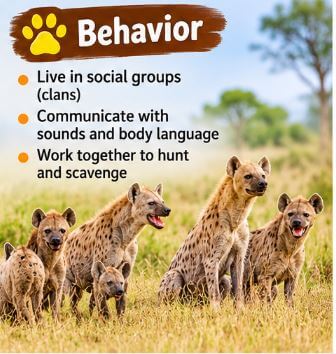
Spotted hyenas have one of the most complex social systems among large carnivores.
Their groups are called clans. A clan may contain many individuals, including adult females, males, and young hyenas.
Female-Dominated Society
Spotted hyena clans are matriarchal, meaning females hold higher social positions than males.
Female spotted hyenas are generally larger and more dominant than males. Social rank can influence access to food, interactions with other clan members, and reproductive opportunities.
Social Hierarchy
Members of a clan live within a dominance hierarchy.
In many populations, rank is strongly influenced by family relationships. Young hyenas can inherit social advantages from their mothers.
This means a young hyena from a high-ranking family may have a higher social position than an unrelated adult from a lower-ranking family.
Do Hyenas Always Stay Together?
No. Although spotted hyenas live in clans, they do not spend every moment together.
Individuals may travel or search for food separately before returning to interact with other clan members.
Scientists describe this type of social organization as a fission-fusion system, in which group members separate and reunite depending on their activities.
8. Hyena Cubs and Reproduction
Female spotted hyenas give birth in dens, where their cubs remain protected during their early development.
A litter commonly contains one or two cubs, although litter size can vary.
Newborn spotted hyena cubs have dark fur and are more developed at birth than many people might expect. They are still dependent on their mothers for milk, protection, and care.
As they grow, cubs begin to explore their surroundings and interact with other young members of the clan.
How Do Hyena Mothers Raise Their Cubs?
Mothers provide milk and protection during the early stages of life.
In spotted hyena clans, communal dens may be used by several mothers and their cubs. However, each mother nurses and cares for her own offspring.
As cubs become older, they gradually develop the skills needed to move around, recognize clan members, and eventually participate in the social life of the group.
9. Why Do Hyenas Have Such Powerful Jaws?
Spotted hyenas have strong jaws and specialized teeth that help them process tough food.
Their powerful bite allows them to crush bones and access nutrients that many other carnivores cannot easily obtain.
This ability is especially useful when feeding on large carcasses.
By consuming parts of carcasses that other animals leave behind, hyenas help recycle nutrients into the ecosystem.
Their jaws are not simply a sign of strength. They are an important adaptation that allows hyenas to make efficient use of available food.
10. Hyena vs. African Wild Dog: What Is the Difference?
Hyenas are sometimes confused with African wild dogs because both are social carnivores found in Africa.
However, they belong to different animal families and have several important differences.
| Feature | Hyena | African Wild Dog |
|---|---|---|
| Animal family | Hyaenidae | Canidae |
| Appearance | Strong build, sloping back, powerful jaws | Slim body, long legs, large rounded ears |
| Social structure | Varies by species; spotted hyenas live in clans | Highly social packs |
| Diet | Varies by species; includes prey, carrion, or insects | Mainly hunts medium-sized mammals |
| Hunting | Spotted hyenas may hunt alone or cooperatively | Often hunts cooperatively |
| Distribution | Africa and parts of Asia, depending on species | Mainly sub-Saharan Africa |
Although they may share some habitats, hyenas and African wild dogs are distinct animals with different evolutionary histories and ecological roles.
11. Are Hyenas Endangered?
The conservation status of hyenas differs by species.
The spotted hyena is currently classified as Least Concern on the IUCN Red List, but this does not mean that all populations are safe. Some local populations face significant pressures.
Other hyena species have different conservation assessments and may face greater risks in parts of their ranges.
Major Threats to Hyenas
Several factors can affect hyena populations:
Habitat Loss
Agriculture, roads, settlements, and other forms of development can reduce natural habitat and separate wildlife populations.
Human-Wildlife Conflict
Hyenas may sometimes attack livestock or approach human settlements while searching for food. This can lead to retaliatory killing.
Declining Prey Populations
When wild prey becomes scarce, hyenas may struggle to find enough food or may come into greater conflict with people.
Persecution and Misunderstanding
Negative beliefs about hyenas can contribute to unnecessary killing. Their reputation as dirty or cowardly animals does not reflect their real ecological importance.
Why Are Hyenas Important to Nature?
Hyenas play valuable roles in their ecosystems.
Spotted hyenas are both predators and scavengers. By hunting prey and consuming carcasses, they help influence animal populations and recycle nutrients.
Their feeding behavior can also reduce the amount of animal remains left in the environment.
Protecting hyenas means protecting the ecological relationships that help keep natural habitats functioning.
12. Frequently Asked Questions About Hyenas
Are hyenas dogs or cats?
Hyenas are neither dogs nor cats. They belong to their own family, Hyaenidae, within the suborder Feliformia. They are more closely related to cats than to dogs.
How many types of hyenas are there?
There are four living species: spotted hyenas, striped hyenas, brown hyenas, and aardwolves.
Do hyenas really laugh?
Spotted hyenas make a giggle-like vocalization that sounds like laughter. It is a form of communication associated with social situations, excitement, or stress, not human-style humor.
What do hyenas eat?
Their diets depend on the species. Spotted hyenas eat animal prey and carrion, while aardwolves feed mainly on termites.
Are hyenas good hunters?
Yes. Spotted hyenas are skilled hunters and can capture a wide range of prey. They also scavenge when opportunities arise.
Do hyenas live in groups?
Spotted hyenas live in social groups called clans. Striped and brown hyenas are generally more solitary, while aardwolves are usually seen alone or in pairs.
Are female hyenas stronger than males?
Female spotted hyenas are generally larger and socially dominant over males. This is a distinctive feature of their social system.
Can hyenas crush bones?
Yes. Spotted hyenas have powerful jaws and specialized teeth that allow them to crush and consume many bones.
Are hyenas dangerous to humans?
Hyenas are wild carnivores and should be treated with caution. They generally avoid people when possible, but they can be dangerous in certain situations. Never approach, feed, or attempt to handle a wild hyena.
Are hyenas endangered?
Conservation status varies by species. The spotted hyena is classified as Least Concern globally, but habitat loss, persecution, and conflict with people can threaten some populations.
Conclusion
Hyenas are far more than the scavengers portrayed in popular stories. They are adaptable carnivores with impressive hunting abilities, powerful jaws, and fascinating social behavior.
The spotted hyena stands out for its female-dominated clans, complex communication, and ability to hunt as well as scavenge. Other members of the hyena family, including striped hyenas, brown hyenas, and aardwolves, have their own unique adaptations and feeding habits.
As important members of their ecosystems, hyenas help maintain the balance of wildlife communities. Understanding these animals more accurately is an important step toward appreciating and protecting them.
References
The following sources provide scientific and educational information about hyena species, habitat, diet, social behavior, and conservation.
- San Diego Zoo Wildlife Alliance. Spotted Hyena.
https://animals.sandiegozoo.org/animals/spotted-hyena - World Wildlife Fund (WWF). Spotted Hyena.
https://www.worldwildlife.org/species/spotted-hyena/ - San Diego Zoo Wildlife Explorers. Spotted Hyena.
https://sdzwildlifeexplorers.org/animals/spotted-hyena - Holekamp, K. E., Smith, J. E., Strelioff, C. C., Van Horn, R. C., and Watts, H. E. (2012). Society, demography and genetic structure in the spotted hyena. Molecular Ecology.
https://doi.org/10.1111/j.1365-294X.2011.05240.x - International Encyclopedia of Life Course and Ecology / San Diego Zoo Global. Spotted Hyena Fact Sheet: Behavior & Ecology.
https://ielc.libguides.com/sdzg/factsheets/spottedhyena/behavior-ecology