

Introduction to the Female Peacock
Common Misconceptions About Peafowls

When most people hear the word “peacock,” they instantly picture the dazzling, flamboyant male bird with his resplendent tail feathers. But that’s only half the story. The female peacock – properly called a peahen – is often overlooked, yet she plays a crucial role in the life cycle, social behavior, and ecosystem of this iconic species. The misconception arises largely due to the cultural obsession with beauty and ornamentation, which the male possesses in abundance. However, if we dig a little deeper, we find that the female peacock brings far more to the table than meets the eye.
Unlike the male, the female doesn’t boast iridescent feathers or a fan-like tail. But this isn’t a flaw—it’s evolution. Her muted brown and green feathers allow her to remain inconspicuous, especially during nesting season when camouflage can mean the difference between life and death for her and her chicks. The female’s appearance might be understated, but her role is profound—both biologically and socially. Her quiet strength, maternal instinct, and complex social behavior are often underappreciated in discussions about peafowls.
Understanding peahens helps us grasp the full picture of peafowl behavior and survival strategies. Just as the male uses his beauty to attract mates, the female uses her intelligence and instincts to ensure the continuity of the species. This article will take a deep dive into the world of the female peacock—from her biology and habits to her role in culture and ecology.
The Importance of Understanding the Female Counterpart
Focusing solely on male peacocks does a disservice to the species. The female plays a central role in mate selection, chick rearing, and social structure. She is not merely a passive observer in the dance of courtship but an active participant who decides which male genes get passed on. Without her, the entire peafowl mating system collapses.
Moreover, learning about female peacocks is essential for conservation. As ground-nesting birds, peahens face unique challenges that threaten their populations—particularly habitat loss and predation. Conservationists need to understand their nesting behavior, feeding needs, and stress responses to effectively protect the species. By appreciating the peahen, we gain insights into not just the species itself, but also into broader ecological dynamics.
Scientific Classification and Terminology
What’s the Correct Term – Peacock vs Peahen vs Peafowl?

Let’s clear this up once and for all: peafowl is the correct term for the entire species. “Peacock” refers to the male, “peahen” is the female, and “peachick” is the baby. It’s similar to how we use the term “deer” to describe the whole species but distinguish “buck” and “doe” based on gender.
This mislabeling is common, partly because male peacocks are more widely known thanks to their flamboyant plumage. But peahens are just as deserving of the spotlight. Scientifically speaking, peafowls belong to the family Phasianidae, which includes other ground birds like pheasants and turkeys. The genus is Pavo, with the most well-known species being Pavo cristatus—the Indian Peafowl.
There are also two other main species: the Green Peafowl (Pavo muticus) and the Congo Peafowl (Afropavo congensis), each with their own distinctions in female appearance and behavior. Regardless of the species, the naming conventions remain consistent, and understanding them helps us communicate more accurately about these fascinating birds.
Taxonomy of the Female Peacock
Let’s break down where the peahen fits in the scientific world:
-
Kingdom: Animalia
-
Phylum: Chordata
-
Class: Aves
-
Order: Galliformes
-
Family: Phasianidae
-
Genus: Pavo
-
Species: Pavo cristatus (most common)
The female’s physiology, though less flashy than the male’s, is specially adapted for survival. Her plumage blends into her surroundings, helping her protect her nest from predators. Her instincts, hormonal cycles, and reproductive system are vital parts of the species’ biology. While males are often praised for their appearance, the female’s contribution lies in the resilience of her body, the sharpness of her senses, and her unwavering dedication to her offspring.
Physical Appearance of the Female Peacock
Coloration and Patterns
If you’re expecting show-stopping colors, you won’t find them here—but that’s the point. The female peafowl is clothed in muted shades of brown, grey, and green, designed to blend seamlessly with the forest floor or tall grasses. These earth-toned feathers act like a cloak of invisibility during nesting season. Some light green and bronze tinges can be found on her neck and chest, giving her a subtle beauty that requires closer inspection to appreciate.
Her lack of a fan-like tail isn’t a defect—it’s a survival trait. While the male flaunts his feathers to attract mates and ward off rivals, the female’s evolutionary path favors camouflage and caution. This isn’t just about hiding—her feathers are structured in such a way that they help regulate body temperature and repel water, which are essential features when raising chicks in unpredictable weather conditions.
Her crest—smaller than the male’s—is still noticeable and stands upright, serving as a subtle communication tool within peafowl groups. When she’s alert or threatened, you’ll see this crest become more rigid, signaling her state of awareness to others nearby.
Differences Between Males and Females
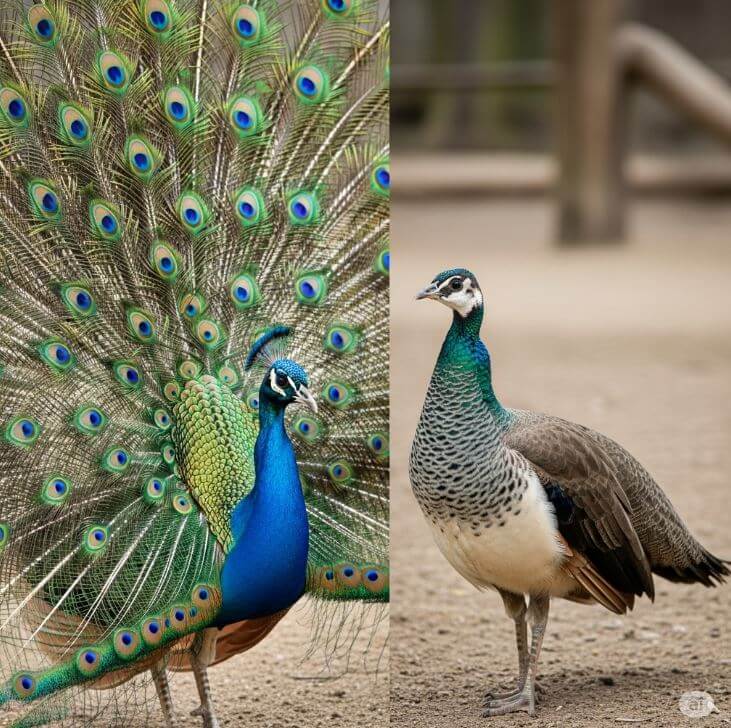
Here’s a quick comparison to make it clear:
| Feature | Male Peacock | Female Peacock |
|---|---|---|
| Tail Feathers | Long, iridescent train | Short, non-decorative tail |
| Coloration | Bright blue, green, gold | Brown, grey, with green hints |
| Crest | Prominent and wide | Smaller and narrow |
| Size | Larger and heavier | Slightly smaller and slimmer |
| Behavior | Display-oriented, flamboyant | Nurturing, cautious, protective |
These differences may seem superficial at first, but they each serve distinct biological purposes. The male uses his features to dazzle and defend; the female uses hers to survive and nurture. Both are beautiful in their own way—one is a spectacle of nature’s extravagance, the other is a masterclass in quiet resilience.
Habitat and Geographic Distribution
Native Regions and Preferred Environments
Female peacocks, like their male counterparts, are native to the Indian subcontinent. You’ll find them in countries like India, Sri Lanka, Pakistan, and Nepal. They thrive in a variety of habitats, including open forests, scrublands, and farmlands—anywhere that offers both food and adequate cover.
The key to a suitable habitat for peahens is camouflage and safety. They prefer areas with dense underbrush or tall grasses, which they use as natural hiding spots when nesting. Trees are also essential, not just for roosting but for providing shade and vantage points against predators.
What’s fascinating is their adaptability. While wild peahens are most commonly found in subtropical and tropical climates, they’ve been introduced to areas across the globe, including parts of Africa, Europe, and the United States. Many adapt well to captivity in zoos or private estates, provided their basic needs—space, diet, and safety—are met.
Adaptability to Captive Settings
Peahens can adapt to a range of human-managed environments. From sprawling estates to backyard farms, they are surprisingly low-maintenance when compared to other exotic birds. However, their well-being depends heavily on appropriate care. They need:
-
Secure enclosures to protect them from predators.
-
A diet that mimics their natural food intake.
-
Enough space to roam and forage.
-
Safe, elevated roosting spots.
Captive environments must also accommodate their instinctive need for nesting. If these needs are met, the female peacock not only survives but thrives—sometimes even living longer than her wild counterparts due to reduced exposure to predators and disease.
Behavioral Traits of the Female Peacock
Social Behavior in the Wild
Peahens are not loners. They are highly social birds, often found in small flocks that include other females and their chicks. These groups offer protection, companionship, and shared parenting insights. In the wild, you’ll rarely find a solitary peahen unless she’s nesting.
Social structure among peahens is more democratic than hierarchical. They communicate through subtle body movements, vocal cues, and spatial positioning. When one senses danger, the entire group becomes alert—a phenomenon that significantly increases their survival chances.
Males may strut around showing off, but peahens form the heart of the community. They guide younger birds, coordinate group movements, and often show remarkable memory when it comes to foraging paths and predator hotspots. They’re also more emotionally intelligent than people realize—recognizing individuals in their group and even forming bonds with their human caretakers in captivity.
Diet and Feeding Habits
What Do Female Peafowls Eat in the Wild?
In the wild, female peacocks (peahens) are opportunistic omnivores. That means they eat a wide variety of foods depending on what’s available in their environment. Their diet typically includes seeds, grains, insects, small reptiles, berries, and even small mammals or amphibians if the opportunity arises. This varied diet provides the essential nutrients they need for energy, reproduction, and survival.
Peahens are particularly skilled foragers. They spend a significant portion of their day on the ground, pecking through the underbrush for food. Their keen eyesight helps them spot tiny insects and movements in the foliage. Unlike some birds that are picky eaters, peahens are practical and adaptable. They’ll consume termites during swarms, worms after a rain, and fruits when they’re in season.
One interesting behavioral trait is their habit of scratching the ground, similar to chickens, to uncover hidden insects or larvae. In forested or agricultural environments, they also help control pest populations by consuming insects that could otherwise damage crops—making them unsung heroes in ecological balance.
Their feeding isn’t just about survival—what they eat directly impacts their reproductive health. A well-nourished peahen is more likely to produce healthy eggs, rear strong chicks, and maintain her energy levels throughout the demanding breeding season. Nutrition is not just about sustenance; it’s about survival, fertility, and maternal endurance.
Diet in Captivity and Nutritional Needs
When in captivity—whether in zoos, aviaries, or private farms—peahens require a balanced diet that mimics their natural feeding habits. Most caretakers offer a mix of:
-
High-quality poultry feed
-
Whole grains (corn, wheat, millet)
-
Fresh vegetables and leafy greens
-
Occasional fruits like grapes, apples, or berries
-
Protein sources like mealworms or cooked eggs
Calcium and vitamin D3 supplements are often added to their diet during the laying season to support eggshell formation and bone strength. Without these, peahens may suffer from poor egg quality or metabolic bone disease, which can be fatal over time.
It’s also important to note that peahens need access to clean water at all times. Hydration plays a crucial role in digestion and maintaining body temperature, especially in hotter climates.
Captive environments should include opportunities for natural foraging—scattering feed across the ground or hiding treats inside logs or under leaves can stimulate natural behaviors and reduce boredom. Healthy peahens in captivity often outlive their wild counterparts because of consistent nutrition, medical care, and protection from predators.
Reproduction and Mating Practices
Role of the Female in Breeding Season

When breeding season arrives—usually during the spring and summer months—the spotlight often falls on the male peacock with his extravagant display. However, it’s the female who holds the real power in this seasonal drama. Peahens are selective breeders. They observe multiple males, sometimes over several days, before choosing a mate. Their choice is influenced by the quality of the male’s display: symmetry, feather length, and courtship dances all play a role. But they’re not fooled by superficial glitz alone. Males also have to prove their health, strength, and intelligence.
Once a peahen selects her mate, she proceeds with nesting and egg-laying. The male may continue courting other females, but the female takes on the full responsibility of reproduction from that point onward. It’s a testament to her strength and resilience that she not only lays the eggs but also incubates them and raises the chicks entirely on her own.
Peahens often choose well-hidden nesting sites—under dense shrubs, near tree roots, or within tall grasses. They may lay between 3 to 8 eggs in a single clutch, though only a few may survive depending on environmental threats. The incubation period lasts about 28 to 30 days, during which the peahen rarely leaves the nest, risking dehydration or predation to protect her eggs.
Egg Laying and Chick Rearing
Once the eggs hatch, the real challenge begins. Peachicks are born precocial, meaning they can walk and feed themselves within a few hours of hatching. However, they still rely heavily on their mother for warmth, protection, and guidance. The peahen’s maternal instincts are extraordinary. She constantly checks her surroundings, uses vocalizations to signal danger, and even fakes injuries to distract predators away from her chicks—a behavior known as “distraction display.”
She leads her brood to feeding grounds, teaching them how to scratch the soil and recognize safe foods. If one strays too far, she quickly brings them back with soft clucks. Her attentiveness during the early weeks of life is the difference between survival and loss for her offspring.
In captivity, successful breeding also depends on proper care and low-stress environments. Providing quiet, shaded areas for nesting and reducing human interference are critical to successful egg incubation. The mother-chick bond in peafowls is strong and lasts until the chicks can fend for themselves, usually around 8 to 12 weeks after hatching.
Communication and Vocalization
Sounds Made by Female Peacocks
Contrary to popular belief, it’s not just the males who are vocal. Female peafowls have a wide range of sounds they use for various purposes. Their vocalizations may not be as loud or flamboyant as the male’s mating calls, but they are just as important—especially for communication with chicks and warning of danger.
Peahens use low-pitched honks, soft clucks, and urgent squawks to communicate. A “cluck” may signal contentment, while a sharp squawk may alert others to nearby predators. These sounds are often subtle and rhythmic, forming a unique language within their social group.
During the nesting period, the peahen becomes particularly vocal with her chicks. She uses gentle chirps to encourage them to follow, feed, or stay hidden. This soft communication is vital in the early stages of life when the chicks are vulnerable and learning how to behave.
Peahens may also call out to locate one another when separated. While not known for musical voices, their communication is precise, purpose-driven, and surprisingly nuanced. These vocalizations foster trust, coordinate group actions, and maintain safety within the flock.
How They Communicate with Their Young and Mates
Communication between the female and her offspring is highly intuitive. Even before hatching, peachicks can hear the mother’s muffled clucks and chirps through the eggshell. This early communication primes them to recognize her voice immediately after birth.
After hatching, peahens teach their young through both sound and body language. If she freezes suddenly or raises her crest, the chicks understand there might be danger. If she fluffs her feathers and calls softly, it might be time to rest. These cues help instill a sense of security and teach peachicks how to respond to their environment.
When it comes to communicating with potential mates, the female is more passive, but still involved. She responds to the male’s display with body posture—facing him, lowering her head slightly, or walking away to show disinterest. Her decision-making process is complex and based on several sensory inputs—sight, sound, and even scent.
Significance in Culture and Symbolism
Role in Folklore and Mythology
While male peacocks dominate artistic representations, peahens also have a special place in culture and mythology. In Hindu mythology, for instance, the goddess Saraswati, symbol of wisdom, is often shown with a peacock—sometimes female—to represent humility and knowledge over vanity. In contrast to the male’s flamboyance, the female symbolizes maternal instinct, loyalty, and discretion.
In some cultures, the peahen is associated with moonlight and the cycle of birth and rebirth, aligning with her role in nurturing life. In rural parts of India, spotting a nesting peahen is considered a sign of good fortune and fertility.
Medieval European texts reference the peahen as a symbol of modesty. While the male struts with pride, the female’s plain feathers were seen as a virtue—quiet strength, faithfulness, and grounded wisdom. In ancient Egypt, peahens were associated with resurrection due to their nurturing behavior and the impressive survival rate of their chicks under attentive care.
Representation in Modern Media
In today’s world, peahens still take a backseat in visual culture, often overshadowed by the flashy males. However, a shift is happening. Wildlife documentaries now shed more light on the complex social and reproductive roles of the female peafowl. In films and animated series, there’s a growing trend of giving personality and depth to the female counterparts of traditionally male-dominated animal characters.
Social media has also played a role in spotlighting the peahen. Birdwatchers and pet owners increasingly share stories and photos of their peahens, showing the charm of their quiet beauty and maternal devotion. This is helping break stereotypes and introduce audiences to the “other half” of this magnificent bird.
Conservation Status and Threats
Natural Predators
In the wild, the female peafowl faces numerous threats from predators, especially due to her ground-dwelling and nesting habits. While adult peahens are agile and capable of flight, their preference for staying close to the ground and the long periods they spend incubating eggs make them especially vulnerable. Common predators include:
-
Foxes and jackals: Particularly in India and nearby regions, these predators actively hunt peahens during nesting periods.
-
Leopards and big cats: These stealthy predators pose a threat not just to peahens, but to the entire peafowl species.
-
Snakes and monitor lizards: These often prey on peafowl eggs or vulnerable chicks, especially when the mother is away foraging.
-
Birds of prey: Eagles and hawks may target chicks or even adult females during flight.
Peahens rely on camouflage and alert behavior to avoid these threats. Their muted feathers allow them to blend into their surroundings, particularly when nesting. They also tend to remain motionless when danger is near, hoping to go unnoticed.
During group foraging, peahens exhibit sentinel behavior—where one remains alert while the others feed—enhancing the chances of early predator detection. These social adaptations are vital for survival but not foolproof.
Human-Induced Dangers and Habitat Loss
Beyond natural predators, the biggest threat to female peacocks today is human encroachment and habitat destruction. As urbanization expands, the open woodlands and agricultural areas where peafowls once thrived are being replaced with cities, roads, and farmlands. This habitat fragmentation disrupts nesting sites and limits access to food and water.
Additionally, hunting—although illegal in many areas—is still practiced in some rural regions where peafowls are seen as pests or are hunted for meat. While the male peacock is often targeted for his feathers, females are sometimes caught inadvertently or intentionally for the bushmeat trade.
Other human-related dangers include:
-
Pesticide use in agriculture, which contaminates their food sources.
-
Road traffic accidents, especially when peafowls cross highways during migrations or feeding.
-
Pet trade, where peahens are sometimes captured and sold illegally.
Climate change also poses a long-term threat. Altered rainfall patterns, rising temperatures, and droughts affect vegetation and insect populations, indirectly impacting the food availability for peahens and their young.
Conservation efforts are underway in several countries, with national parks and wildlife sanctuaries offering safe habitats. Legal protections exist in India and other countries where peafowls are native, but enforcement and public education remain key to ensuring their survival.
Role in Ecosystems
Contribution to Biodiversity
Female peafowls play a crucial role in maintaining the ecological balance of their habitats. As ground foragers, they contribute to seed dispersion and pest control. By consuming insects, grubs, and small reptiles, peahens help manage populations that could otherwise become problematic, especially in agricultural areas.
Their movement across landscapes also aids in aerating the soil and distributing plant seeds. When peahens dig and scratch through the ground for food, they inadvertently help with soil turnover—a vital process for nutrient cycling in natural ecosystems.
Moreover, peafowls—both male and female—serve as prey for larger predators, which helps maintain the food web. The presence of a healthy peafowl population is often an indicator of a thriving ecosystem with balanced predator-prey dynamics.
In forests and protected reserves, peahens help sustain other wildlife indirectly. For instance, abandoned nests may become homes for small mammals or reptiles, and uneaten food scraps are consumed by scavengers. Every aspect of their daily routine—eating, nesting, walking—has a ripple effect across their environment.
Importance of Preserving Female Peafowls
Preserving the female peafowl is not just about protecting a beautiful bird—it’s about maintaining biodiversity, ecological health, and cultural heritage. As the primary nurturers of the species, peahens ensure the survival of future generations. Their role in chick-rearing directly impacts population stability and genetic diversity.
From an ecological standpoint, removing peahens from an area can disrupt food chains and lead to overpopulation of pests. It also reduces the chances of successful mating cycles, since one male often mates with multiple females, but each female only reproduces with one mate per season. This imbalance can threaten long-term population sustainability.
Conservation of female peafowls means:
-
Protecting nesting grounds and natural habitats
-
Educating communities about the ecological value of peahens
-
Preventing illegal hunting and trade
-
Creating incentives for local communities to protect them
Ultimately, ensuring that peahens thrive means supporting entire ecosystems, from insects to apex predators, and everything in between.
Interesting Facts About Female Peacocks
Little-Known Traits and Unique Behaviors
There’s more to the female peafowl than meets the eye. Here are some fascinating facts that show just how complex and intriguing peahens truly are:
-
They recognize individual humans and animals. In captivity, peahens can distinguish between familiar caretakers and strangers, often reacting differently based on their recognition.
-
They can fly well, despite their size. Peahens roost in trees to avoid predators at night and can fly short distances to escape danger.
-
They exhibit strong maternal instincts. Peahens will often defend their chicks aggressively, even against much larger animals.
-
They’re excellent navigators. Peahens have a strong homing instinct and can remember routes to food sources and safe nesting areas.
-
They use “distraction displays.” If a predator approaches, the mother might fake an injury to lure the threat away from her chicks.
These behaviors highlight the intelligence, bravery, and adaptability of female peafowls—traits that often go unnoticed in popular depictions.
Differences Between Subspecies
Not all peahens are the same. Among the three main peafowl species, each female has subtle differences:
-
Indian Peahen (Pavo cristatus): Brown body with green neck and a relatively small crest. Most commonly seen worldwide.
-
Green Peahen (Pavo muticus): More vibrant with greenish scales and longer tail feathers than the Indian variety. Found in Southeast Asia.
-
Congo Peahen (Afropavo congensis): Smaller and less ornate than other species. More secretive and native to Central Africa.
These distinctions reflect not just aesthetics, but evolutionary adaptations to different environments and climates. Understanding these differences helps in breeding programs and conservation strategies tailored to each subspecies.
Female Peafowl vs. Other Birds

Comparison with Other Ground Birds
When comparing peahens to other ground birds like pheasants, turkeys, or quails, several differences stand out. Peahens are more social than quails, more protective than pheasants, and more agile than turkeys. They balance ground foraging with tree roosting, which is not as common among other ground birds.
Unlike most ground birds that rely purely on camouflage or flocking, peahens exhibit complex behavioral traits like sentinel systems and coordinated chick rearing. Their vocal range, memory, and social intelligence give them an edge in survival and communication.
Here’s a quick comparison:
| Feature | Peahen | Pheasant | Turkey | Quail |
|---|---|---|---|---|
| Roosting in Trees | Yes | Rare | Rare | Rare |
| Social Intelligence | High | Moderate | Moderate | Low |
| Vocal Communication | Developed | Limited | Moderate | Basic |
| Maternal Behavior | Strong | Moderate | Moderate | Low |
Unique Features that Set Them Apart
-
Elegant gait and posture: Peahens have a distinctive way of walking, with a graceful, upright posture that gives them an air of quiet dignity.
-
Sharp awareness: Their ability to detect movement and danger makes them among the most cautious birds in the wild.
-
Selective breeding behavior: Unlike many birds that mate based on convenience, peahens are highly selective and strategic.
-
Cultural symbolism: Rarely are ground birds given the level of cultural reverence that female peafowls enjoy in parts of Asia and Africa.
These traits collectively make the female peacock a truly unique and admirable bird.
Keeping Female Peacocks as Pets
Care, Maintenance, and Legal Considerations
Keeping a female peafowl as a pet can be rewarding, but it comes with responsibilities. Before acquiring one, you must first check local regulations, as peafowls are protected or restricted in some areas due to conservation laws or noise ordinances.
Peahens require:
-
A spacious outdoor enclosure: Ideally half an acre or more, with secure fencing.
-
Shelter: A shaded, waterproof structure to protect from rain, wind, and predators.
-
Roosting space: Elevated perches at least 6 feet off the ground.
-
Balanced diet: High-quality poultry feed supplemented with fresh greens and protein.
-
Social interaction: Peahens are flock animals and do best with companions—either other peahens or a balanced male-female group.
Also consider veterinary care, especially during breeding or molting seasons. Regular health checkups, parasite treatments, and vaccinations can go a long way in extending their lifespan.
Things to Know Before You Get One
-
They are loud. Even though peahens are quieter than males, they still vocalize—especially during mating season.
-
They can be territorial. Peahens may show dominance toward new birds or other pets.
-
They fly. Despite their size, they can leap fences and fly into trees, so enclosures must be tall or covered.
-
They live long. A healthy peahen can live 15 to 20 years in captivity, requiring long-term commitment.
Owning a peahen is not just about enjoying her presence; it’s about ensuring her health and happiness through informed, responsible care.
Conclusion
The female peacock, or peahen, may not wear a dazzling crown of feathers like her male counterpart, but her significance in the world of avian beauty and biology is irrefutable. She is the heart and soul of the peafowl species—intelligent, resourceful, and fiercely maternal. Her camouflage-colored feathers are nature’s answer to stealth and survival, allowing her to blend seamlessly into the environment while nurturing the next generation of peachicks.
From the forests of India to protected sanctuaries around the globe, peahens embody grace, resilience, and quiet strength. They choose their mates with discernment, raise their young with unparalleled devotion, and adapt to both wild and captive environments with equal prowess. While the male peacock dazzles us with his tail, the peahen commands respect through her actions and instincts.
As we’ve explored, her role in ecosystems is essential, her contribution to biodiversity is immense, and her place in culture is sacred—despite being overshadowed in the public eye. Whether you’re a birdwatcher, a nature enthusiast, or simply someone looking to understand the beauty of life beyond the surface, appreciating the female peafowl is a rewarding journey. She may be the unsung beauty of the bird world, but her song is one of courage, care, and quiet splendor.
FAQs
1. Do female peacocks have feathers like males?
No, female peafowls (peahens) do not have the long, iridescent tail feathers that males use for display. Instead, their feathers are brown, grey, and green, which help them stay camouflaged in their environment—especially when nesting.
2. Are female peacocks aggressive?
Peahens are generally not aggressive, but they can become fiercely protective during nesting or when caring for their young. If they sense danger, they may try to distract predators or attack smaller threats.
3. How can you tell a female peacock from a male?
Females have duller, earth-toned feathers and lack the extravagant tail train that males possess. They’re slightly smaller in size, have a subtler crest, and are more cautious in behavior.
4. What is the lifespan of a female peacock?
In the wild, a peahen typically lives around 10 to 15 years. In captivity, with proper care, they can live up to 20 years or more due to the absence of predators and regular medical care.
5. Can female peacocks fly?
Yes, peahens can fly short distances despite their size. They often fly into trees to roost at night or escape predators. Their flights are short and sudden, used more for survival than long-distance travel.