

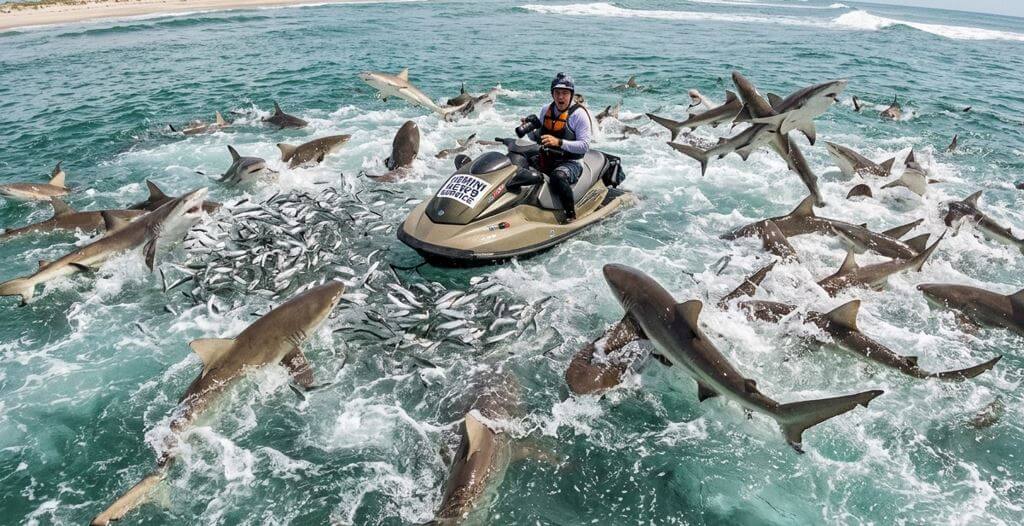
HATTERAS, NC — In a scene that looks like a high-budget Hollywood thriller, the Atlantic waters off North Carolina’s Outer Banks have become the stage for a dramatic display of apex predator power. In the last 24 hours, stunning GoPro footage from local fisherman and surfer Brett Barley has gone viral, capturing him at the literal center of a massive shark feeding frenzy near Cape Point.
A Four-Acre “Boiling” Ocean
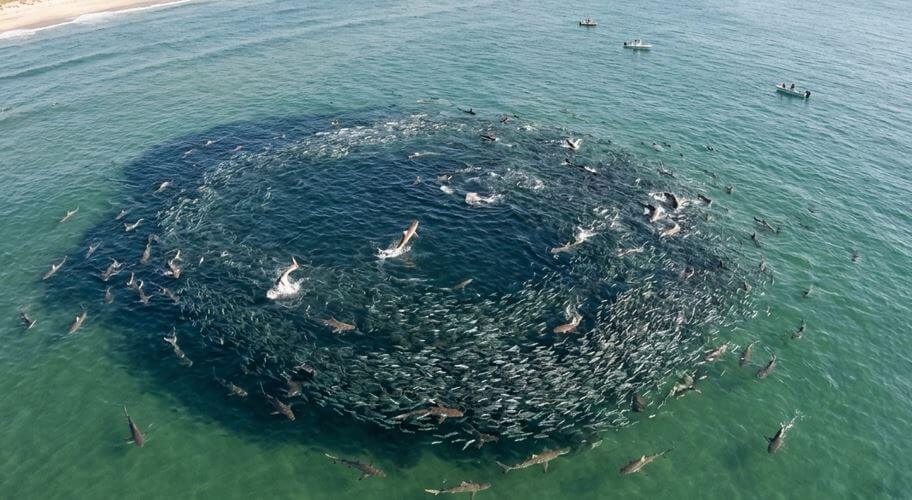
The encounter, which Barley described as “engulfing” his personal watercraft, featured hundreds of sharks—primarily Spinner sharks—tearing through a massive bait ball. The activity wasn’t just limited to the depths; witnesses and video evidence show sharks leaping into the air, or “skying,” as they pursued prey with terrifying speed.
“I’m very fortunate one didn’t sky right into me or all my gear,” Barley shared on social media, noting that the frenzy covered an estimated four-acre area.
Adding to the chaos, a large school of Red Drum joined the predators, creating a multi-species “blitz” that turned the water into a frothing, silver-and-gray cauldron.
The “Great White” Highway
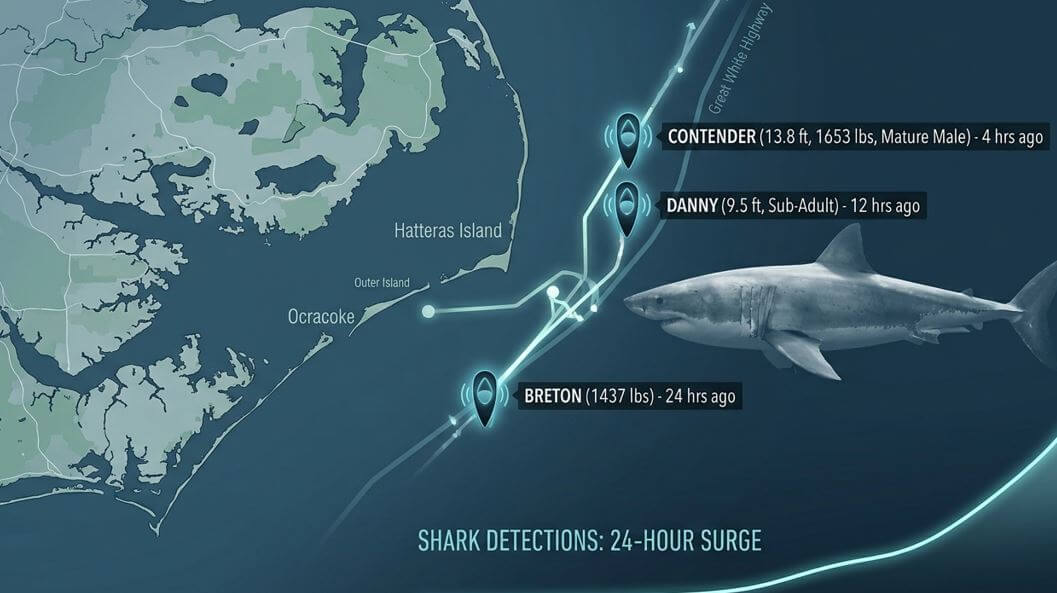
While the Spinner sharks provided the surface-level spectacle, deeper tracking data suggests the frenzy is part of a larger, more formidable migration. OCEARCH, the marine research organization, has reported a surge in “pings” from tagged Great White sharks along the North Carolina coast this week.
-
“Contender”: A massive 13.8-foot, 1,653-pound mature male was detected just east of Hatteras Island.
-
“Danny”: A 9.5-foot sub-adult was tracked near Oregon Inlet within the last 48 hours.
-
“Breton”: A 1,437-pound Great White also pinged recently, confirming that the “Great White Highway” is currently heavily trafficked as these giants migrate north.
Why Now? The Science Behind the Madness
Marine biologists point to the seasonal migration of baitfish, such as menhaden and mullet, as the primary trigger. As water temperatures hit the “sweet spot” in mid-April, predator and prey converge in the shallow, nutrient-rich waters of the Outer Banks.
Experts warn that while these “frenzies” are natural and vital for the ecosystem, they pose a significant risk to small-craft mariners and surfers. The sheer density of the sharks in Barley’s footage—some coming within inches of his vessel—serves as a visceral reminder of the “no-go” zones for humans during a bait blitz.
Safety Brief for the Outer Banks:
-
Avoid the “Bait”: Do not enter the water if you see large schools of fish or diving birds.
-
Color Caution: Avoid wearing high-contrast clothing or shiny jewelry (which can look like fish scales).
-
Time of Day: Stay out of the water during dawn and dusk when predatory activity peaks.
For now, the residents of the Outer Banks are watching the horizon with a mix of awe and caution. As the bait balls move, so does the frenzy—reminding us all who truly rules the Atlantic.