

ATLANTA, Georgia — June 5, 2026 — Wildlife officials in the U.S. state of Georgia have intensified warnings about the spread of the invasive Argentine black-and-white tegu, a large South American lizard that experts say poses a serious threat to native wildlife, agriculture, and ecosystem stability. Over the past 24 hours, renewed public alerts from state agencies and widespread media coverage have drawn national attention to the growing challenge facing Georgia’s conservation authorities.
The latest warnings come as the Georgia Department of Natural Resources (DNR) urges residents to report sightings of the reptiles and, where legally permitted, humanely trap or euthanize them. Officials describe the species as one of the most concerning invasive reptiles currently expanding across the southeastern United States.
Contents
- 1 A Growing Invasion in Georgia
- 2 Why Officials Are Concerned
- 3 A Threat to Native Wildlife
- 4 Agricultural Concerns
- 5 Disease and Parasite Risks
- 6 Rapid Reproduction Fuels Expansion
- 7 Georgia’s Response Strategy
- 8 Lessons from Florida
- 9 The Exotic Pet Connection
- 10 Public Cooperation Becomes Essential
- 11 Looking Ahead
A Growing Invasion in Georgia
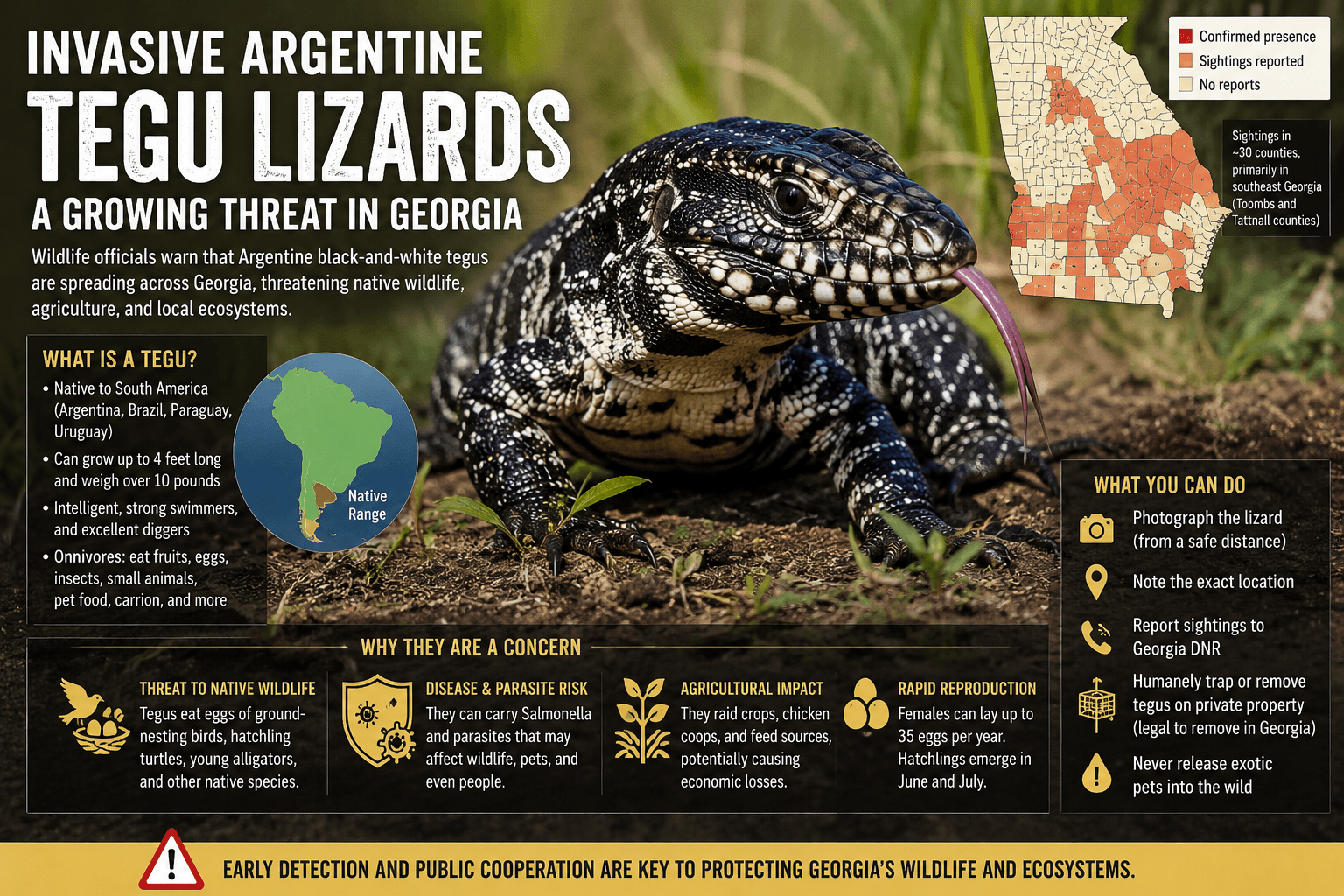
The Argentine black-and-white tegu (Salvator merianae) is native to South America, particularly Argentina, Brazil, Paraguay, and Uruguay. Although the species has long been popular in the exotic pet trade because of its intelligence and relatively calm temperament, wildlife biologists believe escaped or intentionally released pets have established breeding populations in parts of the United States.
In Georgia, the problem first emerged in 2018 when state wildlife officials began investigating reports of unusually large lizards in the southeastern portion of the state. Since then, the number of confirmed sightings has steadily increased.
Recent reports indicate that tegus have become established primarily in Toombs and Tattnall counties. However, sightings have now been reported in approximately 30 counties across Georgia, raising concerns that the species may be spreading faster than previously anticipated. Wildlife experts warn that the current distribution could represent only a fraction of the true population because tegus are notoriously difficult to detect in the wild.
The renewed warnings issued this week reflect growing concern among state officials that the reptiles could expand their range significantly if aggressive control measures are not maintained.
Why Officials Are Concerned
Unlike many invasive reptiles that struggle to adapt outside their native climates, Argentine tegus have demonstrated a remarkable ability to survive in the southeastern United States.
The reptiles can grow to nearly four feet in length and weigh more than ten pounds. They are strong swimmers, capable diggers, and highly adaptable predators. More importantly, they can survive colder temperatures than many tropical reptiles by entering a hibernation-like state known as brumation during winter months. This ability allows them to persist in Georgia’s climate and potentially expand farther north.
According to wildlife officials, tegus are opportunistic omnivores that consume almost anything they can find. Their varied diet includes fruits, vegetables, insects, eggs, small mammals, reptiles, carrion, pet food, and agricultural products. This flexibility makes them particularly successful invaders because they are not dependent on a single food source.
The concern is not simply that tegus survive in Georgia—it is that they thrive there.
A Threat to Native Wildlife
One of the primary reasons conservation agencies are alarmed is the tegu’s impact on native species.
Ground-nesting birds are among the most vulnerable. Tegus actively seek out nests and consume eggs belonging to species such as wild turkeys and quail. In ecosystems where bird populations already face pressures from habitat loss and climate change, additional predation from invasive species can further reduce reproductive success.
The reptiles also pose a threat to several species of conservation concern. Wildlife biologists have documented tegus feeding on hatchling gopher tortoises, a species already facing significant habitat pressures across the Southeast. Young American alligators and their eggs are also vulnerable to tegu predation.
Because many native species evolved without large terrestrial lizard predators, they may lack effective defenses against tegus. Scientists fear that established tegu populations could alter predator-prey relationships across entire ecosystems.
Invasive species are among the leading causes of biodiversity decline worldwide, and experts caution that the tegu’s ecological effects could become increasingly difficult to reverse if populations continue expanding.
Agricultural Concerns
Beyond wildlife impacts, state officials are increasingly concerned about agricultural consequences.
Georgia has one of the largest agricultural economies in the United States, producing a wide variety of crops and livestock products. Tegus are known to consume fruits, vegetables, eggs, and animal feed, creating the potential for economic losses among farmers.
The reptiles have also been observed raiding chicken coops and consuming poultry eggs. While current documented agricultural damage remains limited, experts warn that larger populations could significantly increase the risk to farms and rural properties.
The possibility of crop contamination has become another area of concern. Like many reptiles, tegus can carry Salmonella bacteria, which can be transmitted through contact with feces or contaminated surfaces. Wildlife officials worry that increased interaction between tegus and agricultural areas could introduce additional biosecurity challenges for producers.
Disease and Parasite Risks
Public health concerns are not the primary focus of the current warnings, but they remain part of the broader discussion.
Researchers note that Argentine tegus can carry Salmonella and may also transport parasites not commonly found among native wildlife populations. Although the reptiles are generally not considered aggressive toward humans, their ability to introduce pathogens into new environments is viewed as a significant ecological concern.
Officials emphasize that residents should avoid unnecessary handling of the animals and should follow recommended reporting procedures when sightings occur.
Rapid Reproduction Fuels Expansion
Perhaps the greatest challenge facing wildlife managers is the species’ reproductive capacity.
Female tegus can lay up to 35 eggs annually, allowing populations to increase quickly once breeding populations become established. Hatchlings in Georgia typically emerge during June and July, meaning wildlife agencies are entering one of the most critical periods of the year for population control efforts.
Because juvenile tegus mature relatively quickly, even small breeding populations can generate substantial population growth over a short period.
Wildlife managers often describe invasive species control as a race against reproduction. Once populations reach a certain threshold, eradication becomes dramatically more expensive and difficult.
Georgia’s Response Strategy
The Georgia Department of Natural Resources has spent years attempting to contain the invasion.
Current efforts involve collaboration with federal agencies and academic researchers, including the U.S. Geological Survey and Georgia Southern University. These partnerships focus on trapping programs, population monitoring, habitat assessment, and research into effective management strategies.
Officials have encouraged residents to photograph any suspected tegus, document their locations, and report sightings immediately. Public participation has become a central component of the state’s management strategy because wildlife officers cannot monitor every area where the reptiles may occur.
Unlike many native reptiles, Argentine tegus are not protected under Georgia wildlife law. Residents may legally remove them on private property, subject to applicable regulations and safety considerations. The state’s message has become increasingly direct: early detection and rapid response offer the best chance of preventing a larger ecological problem.
Lessons from Florida
Georgia’s concern is partly informed by experiences elsewhere in the Southeast.
Florida has spent years battling multiple invasive reptile species, including Burmese pythons, green iguanas, and Argentine tegus. In parts of Florida, tegu populations have become well established, creating ongoing management challenges for wildlife agencies.
Researchers studying Florida’s experience have documented the species’ ability to expand rapidly and adapt to diverse habitats. Those findings have influenced Georgia’s decision to pursue aggressive containment efforts before populations become larger and more widespread.
The situation serves as a cautionary example of how quickly invasive reptiles can transform local ecosystems when left unchecked.
The Exotic Pet Connection
Many experts point to the exotic pet trade as the original source of the invasion.
Argentine tegus are frequently sold as pets because they can become relatively tame when raised in captivity. However, their large adult size, specialized care requirements, and long lifespan often surprise owners.
As a result, some animals are abandoned or intentionally released into the wild when owners can no longer care for them. Wildlife agencies across the United States have repeatedly warned that releasing exotic pets can have severe ecological consequences.
The Georgia case highlights a broader national debate about the regulation of exotic animal ownership and the responsibilities associated with keeping non-native species.
Public Cooperation Becomes Essential
Officials stress that the battle against invasive tegus cannot be won by government agencies alone.
Residents living in affected areas are being encouraged to secure pet food, eliminate brush piles that could provide shelter, and fill potential burrows around homes and properties. Public awareness campaigns have expanded as agencies attempt to improve early detection rates.
Wildlife biologists note that invasive species management often succeeds only when local communities actively participate in reporting and prevention efforts.
The challenge is particularly urgent because every breeding season provides another opportunity for population growth.
Looking Ahead
As summer begins and hatchling season approaches, Georgia’s wildlife managers face a critical test.
The state has made progress in trapping and removing tegus since the first confirmed reports in 2018, yet the expanding geographic range suggests the species remains firmly established in portions of southeastern Georgia. Recent warnings indicate that officials view the coming months as a pivotal period in determining whether the invasion can be contained or whether it will continue spreading across the region.
For now, conservation agencies are relying on a combination of scientific research, public cooperation, and targeted removal efforts. Whether those measures will be enough remains uncertain.
What is clear, however, is that the Argentine black-and-white tegu has evolved from an unusual wildlife sighting into one of Georgia’s most closely watched environmental challenges. The state’s response over the next several years may ultimately determine whether the species becomes a permanent fixture of the southeastern landscape—or a rare example of a successful invasive species eradication effort.